Need to flesh out this idea, but seems to me that just as a good leader would delegate much of the heavy lifting work while coaching a strong team to success of her vision / goals, mothers would benefit from delegating much of the "grunt work" with respect to raising children while still maintaining a strong family (team) unit.
I have an au pair who just sent me 4 pictures of my 5 year old son on his last day of preschool sitting with two teachers that he has had for 4 years. He looks happy, they look happy, and I am so pleased that he has these three women (au pair, two great teachers) whom he has learned to trust, count on, learn from, and respect. He still trusts, counts on, learns from, and respects me! But I don't have to be the one doing every little thing. There are things I'm willing to outsource, and things that I am not; it's not about being the one to do everything, it's about being there for a good portion of the time and doing the most important things. If someone else helps get the clothes on and breakfast on the table, but I'm there for a long hug and kiss and some fun conversation in the morning, everyone is happier and things seem to run more smoothly.
Really need to flesh this one out, but wanted to get it out there before I lost it. :-)
Wednesday, June 14, 2017

Women into the C-Suite Means Keeping Them in the Talent Pipeline
Women into the C-Suite Means Keeping Them in the Talent Pipeline
Dean Sally Blount on supporting women through three “pivot points” in their careers.
https://insight.kellogg.northwestern.edu/article/getting-more-women-into-the-c-suite-means-keeping-them-in-the-talent-pipeline
Wednesday, May 31, 2017
Research on Flexible Schedules
https://www.bustle.com/p/this-website-highlighting-flexible-jobs-for-women-will-prevent-women-from-getting-edged-out-of-the-workplace-36940
"Significant numbers of women leave the workforce when they have children. According to a 2016 study, 30 percent of women with BA’s stop working when they have kids, while 19 percent of women with master’s degrees and 26 percent of women without a BA leave the workforce. Research has shown that flexibility is key for a lot of female workers. A 2013 Pew Research Center poll, for example, found that 70 percent of working moms said that having a flexible work schedule is “extremely important” to them. Only 48 percent of working dads said the same."
same stats:
http://mentalfloss.com/article/92051/inflexible-schedules-can-keep-women-working-job-site-aims-change
This site looks awesome! $48/year to join and look for flexible jobs
https://www.saywerk.com/
30% of talented women are dropping out of the workforce but 70% of that group say they would still be working if they had flexibility. Employees no longer work standard hours in a single space with one parent at home. Corporate policies need to be updated to reflect these modern realities. We cannot parent like we don’t have jobs and work like we don’t have children.
Wednesday, December 14, 2016
One more confidence article
Citing the 5 Levels of Leadership by Jim Collins:

https://open.buffer.com/confidence-humility/

https://open.buffer.com/confidence-humility/
Confidence Gap: Women and Men (references)
Evidence shows that women are less self-assured than men—and that to succeed, confidence matters as much as competence. Here's why, and what to do about it.
http://www.theatlantic.com/magazine/archive/2014/05/the-confidence-gap/359815/
You’ve probably heard the following statistic: Men apply for a job when they meet only 60% of the qualifications, but women apply only if they meet 100% of them. The finding comes from a Hewlett Packard internal report, and has been quoted in Lean In, The Confidence Code and dozens of articles.
https://hbr.org/2014/08/why-women-dont-apply-for-jobs-unless-theyre-100-qualified
For women, not wanting to face failure was a big reason they didn’t apply. Almost one in four surveyed said their top reason for not going after the job was: “I didn’t think they would hire me since I didn’t meet the qualifications and I didn’t want to put myself out there if I was likely to fail.” Only 13% of men said this.
The other big gender difference Mohr found: In a job hunt, women are more likely than men to play by the rules. While 15% of women said the main reason they didn’t apply was because “I was following the guidelines,” only 8% of men said so.
http://www.forbes.com/sites/nextavenue/2014/09/11/are-women-too-timid-when-they-job-search/#35777cd52f83
Monday, January 4, 2016
More on Employee Engagement
http://www.gallup.com/topic/employee_engagement.aspx
Many articles here.
For example:
Many articles here.
For example:
Engaged Employees Less Likely to Have Health Problems
http://www.gallup.com/poll/187865/engaged-employees-less-likely-health-problems.aspx?g_source=EMPLOYEE_ENGAGEMENT&g_medium=topic&g_campaign=tiles
Female Bosses More Engaging than Male Counterparts
http://www.gallup.com/businessjournal/183026/female-bosses-engaging-male-bosses.aspx
"Leaders should also know that female managers themselves tend to be more engaged than male managers."
"Employees who work for a female manager are six percentage points more engaged, on average, than those who work for a male manager -- 33% to 27%, respectively."
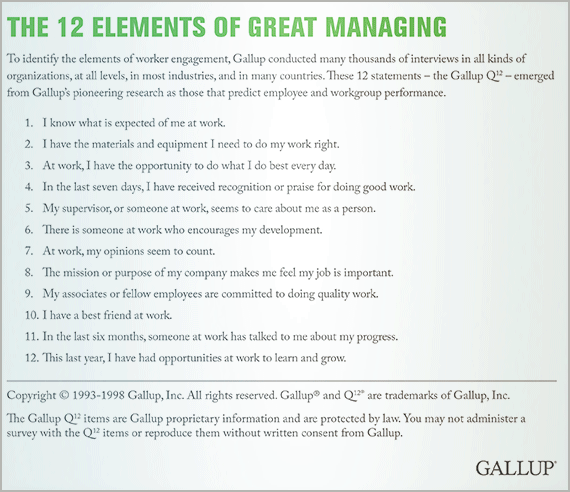
"Leaders should also know that female managers themselves tend to be more engaged than male managers."
"Employees who work for a female manager are six percentage points more engaged, on average, than those who work for a male manager -- 33% to 27%, respectively."
Subscribe to:
Posts (Atom)